
by admin | Aug 11, 2026 | Uncategorized
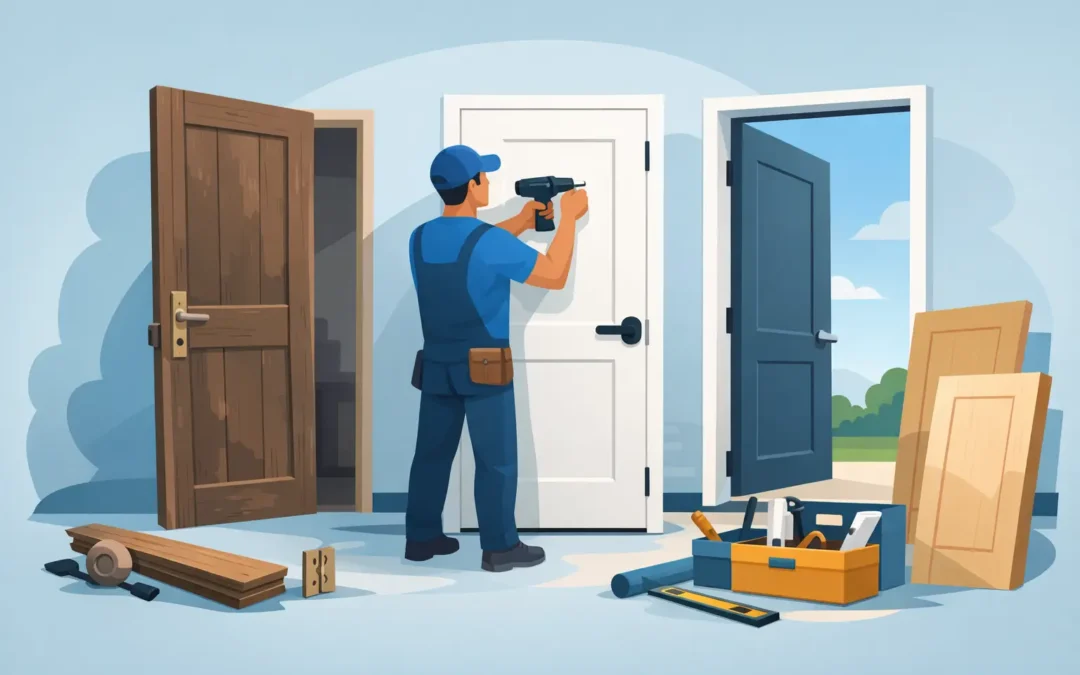
A sticking front door can feel like a small annoyance until it lets in a draught, rattles in its frame or leaves you worrying about security. Door replacement is often the sensible answer when repairs are becoming frequent, performance has slipped, or your home simply no longer looks the way you want it to.
A new door should do more than look smart from the pavement. It needs to close securely, keep the weather outside, suit the character of the property and work properly every day. The right choice depends on where the door is fitted, how you use it and what you want to improve.
Signs You May Need Door Replacement
Not every tired-looking door needs replacing straight away. A loose handle, worn letterbox or faulty lock can often be repaired, and replacement glass may solve misting or a cracked glazed panel. However, there comes a point where putting more money into an old door stops making sense.
Persistent draughts are one of the clearest signs. If you can feel cold air around the frame when the door is shut, the seals may have failed, the door may have warped, or the frame may no longer be sitting square. Condensation between panes of double glazing, visible gaps, rot around timber frames and water coming in during heavy rain also deserve prompt attention.
Security is another reason homeowners choose to upgrade. Older doors can have dated locking systems, weak panels or frames that have deteriorated over time. A modern replacement door with suitable locks, a solid frame and professionally fitted hinges provides everyday reassurance without making the entrance feel over-engineered.
You may also be ready for a change because the layout of your home has changed. Replacing a back door with French doors, patio doors or bi-fold doors can bring more light into a kitchen or living space and make access to the garden easier. That is a larger project than a like-for-like swap, but it can change how a room feels and functions.
Choosing the Right Replacement Door
The best door is not always the most expensive one. It is the one that suits the opening, the property and your priorities. A survey before ordering is essential, particularly in older homes where openings are not always perfectly square.
Composite doors for a strong front entrance
Composite doors are a popular choice for front doors because they combine a solid feel with low maintenance. They are available in a wide range of colours, glazing designs and furniture options, so it is possible to create a traditional or more contemporary look without the upkeep associated with painted timber.
They are particularly useful when warmth, security and kerb appeal are all high on the list. The trade-off is that styles and finishes vary between products, so it is worth seeing samples and discussing what will work with your existing windows, brickwork and porch.
PVC-u doors for practical everyday use
PVC-u doors offer a reliable, cost-conscious option for front, side and rear entrances. They are easy to maintain, do not need painting and can be made with glazed panels to bring more daylight into a hallway or utility room.
A PVC-u door can be a very good fit for a straightforward replacement, especially where value and weather resistance are the main concerns. The key is good installation. Even a well-made door will not perform properly if the frame, seals and thresholds are poorly fitted.
Aluminium, French, patio and bi-fold doors
For wider openings, aluminium doors can provide slim sightlines and a clean, modern finish. They are commonly chosen for garden-facing rooms because they allow more glass and less frame, helping light travel through the home.
French doors work well where you want a traditional pair of opening doors without changing the whole rear wall. Patio doors are practical where space is limited, as the panels slide rather than swing into the room or garden. Bi-fold doors can open a larger section of wall, making them ideal for entertaining and easy access outdoors, although they need enough clear space to stack back.
There is no single winner between these options. Consider how often the doors will be opened, whether furniture restricts the opening, which way the room faces and how much of the garden you want to connect with the house.
What Matters Beyond the Door Itself
It is easy to focus on panel design and colour, but the surrounding details make a real difference to comfort and long-term performance. The frame should be sized and fitted correctly, the threshold should be practical for the people using it, and the glazing should suit the level of privacy and light needed.
For a front entrance, think about sightlines from the street and from inside the house. Decorative or obscured glass can brighten a dark hall while retaining privacy. For a rear door, clear glazing may be the better choice if the garden is private and daylight is the priority.
Hardware deserves attention too. Handles, hinges, letterboxes and locks are the parts you touch most often. Choosing a finish that works with your windows and exterior fittings helps the door look considered, while quality hardware makes day-to-day use feel more secure and reliable.
Colour is another practical decision. A bold front door can give a plain frontage real character, but neutral tones tend to have broad appeal and can be easier to pair with future changes to windows or render. Dark colours often look striking, although they can show dust and marks more readily in exposed locations.
A Straightforward Door Replacement Process
A good door replacement project should feel clear from the first conversation. You should be able to explain what is not working with your current door, what you would like instead and whether there are any concerns around warmth, security, access or appearance. A helpful adviser will then talk through suitable options rather than pushing the most costly one.
The survey is where the detail is checked properly. Measurements, frame condition, opening direction, floor levels and any building work required should all be considered before the door is made. This reduces the risk of surprises on installation day and ensures the finished door operates as it should.
Installation is not just a case of taking one door out and putting another in. The old frame may need careful removal, surrounding finishes need protecting, and the new frame must be level, secure and properly sealed. The door should then be adjusted, tested and checked with you before the work is signed off.
For homes in South East London and Kent, a local installer who can survey, fit and deal with future repairs can be especially useful. If a lock needs attention or a handle wears out later, it is reassuring to know there is practical support available rather than a call centre at the end of a long chain.
Questions Worth Asking Before You Commit
Before accepting a quote, ask what is included in the price and whether removal and disposal of the old door are covered. Confirm the proposed door style, colour, glazing, handles, locking system and threshold, rather than relying on a general description. If there is building work involved, ask how the inside and outside will be finished around the new frame.
It is also sensible to ask about guarantees, maintenance and what to do if an adjustment is needed after fitting. Doors can settle slightly in the first period of use, especially where a property moves with seasonal temperature changes. Knowing who will deal with any follow-up gives you confidence from the start.
Avoid making a decision based on a time-limited sales pitch. A replacement door is a visible, long-term part of your home. Take time to compare the practical differences between options, not just the headline price.
A well-chosen door should make arriving home feel better: quieter when it is shut, warmer on cold days and easier to use every time you carry in shopping, welcome guests or step out into the garden. Start with the problem you want solved, ask straightforward questions, and choose an installer who gives you clear answers.
by admin | Aug 9, 2026 | Uncategorized
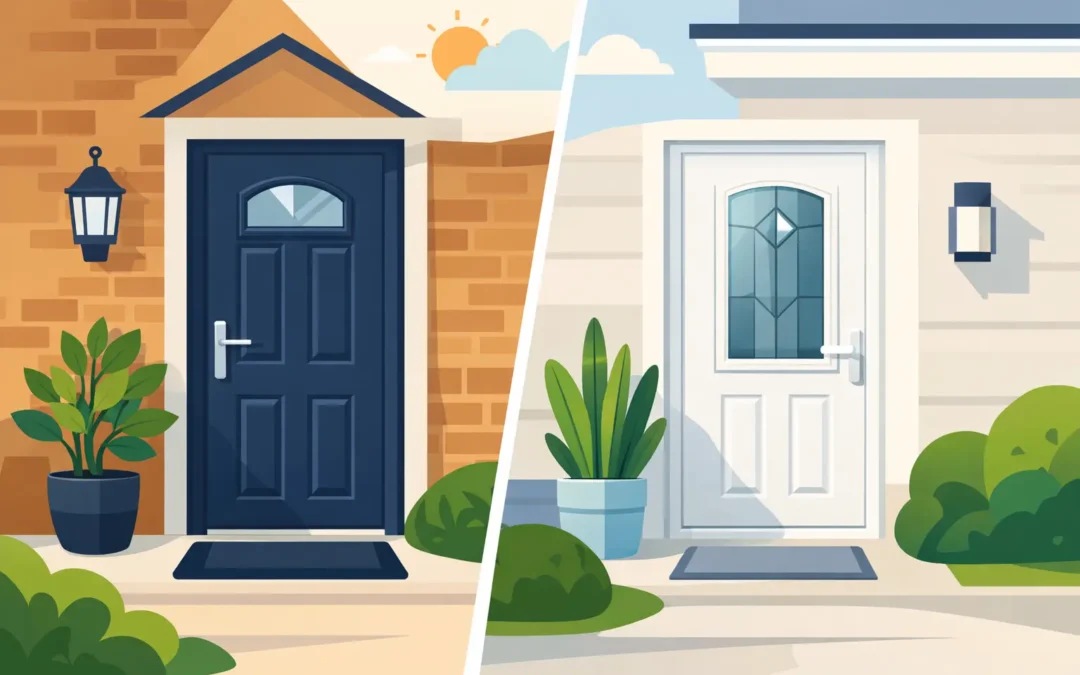
A new front door has a bigger job than most people give it credit for. It needs to make your home feel secure, keep draughts out, stand up to daily use and look right from the pavement. When weighing up composite vs uPVC doors, the best choice is not always the most expensive one. It is the one that suits your property, priorities and budget for the years ahead.
Both are popular, low-maintenance options for homes across south east London and Kent. They can provide good insulation, reliable security and a smart finish without the regular painting associated with a traditional timber door. The differences lie in how they are made, how they look and how they perform in everyday use.
Composite vs uPVC Doors: the main difference
A uPVC door is made principally from unplasticised polyvinyl chloride, usually with steel reinforcement in key areas of the frame and sash. It is a practical, cost-effective material used widely for windows and doors. Modern uPVC entrance doors are a considerable step up from older, thin-looking designs, with improved security, glazing choices and decorative panels.
A composite door uses a combination of materials. While specifications differ between manufacturers, this commonly includes a solid or insulated core, a reinforced frame, a durable outer skin and weather-resistant finishes. The layered construction is designed to give the door more weight, strength and a more substantial appearance.
In straightforward terms, uPVC is often the sensible value option. Composite is usually the premium option, particularly for a main front door where appearance, feel and security are high on the list.
Appearance and kerb appeal
The visual difference is often the first thing homeowners notice. Composite doors tend to have a deeper, more solid profile and can closely recreate the look of a painted timber door. They are available in a broad choice of colours, woodgrain finishes and traditional or contemporary styles. Details such as decorative glazing, side panels, handles and door furniture can make a major difference to the finished look.
This makes composite a strong choice for period properties, homes with character features, or anyone wanting their entrance to make more of a statement. A well-chosen colour can lift the whole front of a house without changing anything else.
uPVC doors have a cleaner, simpler appearance. White remains a popular choice, though coloured and wood-effect finishes are available. They work especially well where you want the door to match existing uPVC windows, rear doors or porch glazing. For a side entrance, utility room or back door, the understated look is often exactly what is needed.
Neither material is automatically better-looking. A poorly matched composite door can feel out of place on a modest property, while a well-designed uPVC door can look neat, bright and entirely appropriate. It comes down to the style of the house and how prominent the door is.
Security: look beyond the door material
A composite door is generally heavier and more rigid than a standard uPVC door. That solid feel is reassuring, but security depends on the complete installation rather than the slab alone. The frame, hinges, locking mechanism, cylinder, glazing and fitting all matter.
A quality uPVC door with reinforced sections, a multi-point lock and an appropriate anti-snap cylinder can offer very good protection. Equally, a composite door needs correctly fitted locks and hinges to perform as it should. The right door installed poorly can leave gaps, catch on the frame or fail to lock smoothly.
When comparing quotations, ask what is included rather than relying on broad claims. Check the locking system, cylinder specification, hinge security, glazing options and whether the surveyor has considered the condition of the existing opening. Clear answers are more useful than sales language.
Warmth, draughts and energy efficiency
Both composite and uPVC doors can help improve comfort compared with an ageing timber door or an older, poorly fitting plastic door. A correctly measured and fitted replacement should reduce draughts around the entrance and make the hallway feel less cold in winter.
Composite doors often have an advantage because of their insulated core and substantial construction. This can provide strong thermal performance, particularly where the door is exposed to wind or faces a busy, open street. However, the overall result still depends on the frame, seals, threshold and glass panels. A door with extensive decorative glazing will perform differently from a solid design.
Modern uPVC doors also offer effective thermal insulation. For many households, the difference in day-to-day warmth between a good uPVC door and a good composite door may not be dramatic enough on its own to justify a higher outlay. If energy efficiency is your main concern, it is worth discussing the exact door specification and how it will be fitted rather than assuming one material always wins.
Cost and long-term value
Price is usually where the choice becomes clearer. uPVC doors generally cost less to supply and install than composite doors. That makes them particularly attractive for rental properties, secondary entrances, annexes, garages and homes where several upgrades are being planned at once.
Composite doors are normally more expensive because of their materials, construction and finish options. For many homeowners, the additional cost is worthwhile for the stronger feel, enhanced appearance and the fact that the front door is used and seen every day. Others would rather put the saving towards replacement windows, a new patio door or another home improvement.
It helps to think about value over the life of the door, not just the initial figure. Consider how long you expect to stay in the property, whether the door is a main entrance or a back door, and how much the appearance of the frontage matters to you. There is no benefit in stretching the budget for features you do not need, but choosing purely on the lowest price can be frustrating if the finished door does not give you the look or feel you wanted.
Maintenance and everyday use
One reason both options remain popular is that they are straightforward to look after. Routine cleaning with warm soapy water and a soft cloth is usually enough for the door and frame. Avoid harsh abrasives, as these can damage the finish.
uPVC is low-maintenance and does not require painting or staining. Over time, very light-coloured doors may show dirt more readily, particularly near a main road or driveway, but regular cleaning keeps them looking tidy. Moving parts and locks benefit from occasional checking and suitable lubrication.
Composite doors are also designed for low maintenance and their outer finishes generally cope well with normal British weather. They can be a good option for an exposed entrance, although no door is entirely maintenance-free. Keep drainage channels clear, wipe down seals and deal with small adjustment issues before they become bigger problems.
The quality of installation has a lasting effect here. A door that is square, properly packed and adjusted should close cleanly, seal properly and operate without excessive force. This is one reason a proper survey matters before an order is finalised.
Which door works best for your property?
A composite door is often the right fit if your front entrance is highly visible, you want a more traditional or premium finish, or you value the solid feel of a heavier door. It can suit detached, semi-detached and period homes particularly well, but there are contemporary designs for newer properties too.
A uPVC door may be the better choice if budget is a priority, you need a reliable rear or side door, or you want to match existing uPVC frames. It is also a sensible solution where simplicity matters more than elaborate styling. A well-specified uPVC door is not a compromise in security or warmth simply because it costs less.
Before making a decision, look at physical samples where possible. Open and close the doors, compare the finishes in natural light and consider the hardware you will use every day. A practical survey should also account for the threshold, surrounding brickwork or render, existing glazing and any access requirements.
The right choice should feel straightforward, not pressured. At Pearson Glazing, the focus is on helping you choose a door that fits the home and the job, with clear advice from survey through to installation. Whether you choose composite or uPVC, a properly specified and carefully fitted door will make the difference each time you come home.
by admin | Aug 7, 2026 | Uncategorized
A patio door has a bigger job than simply getting you into the garden. It affects how much daylight reaches the room, how easily you move furniture outside, how warm the space feels in winter and how your home looks from both sides of the glass. The best patio doors for homes are therefore not one single style. They are the doors that suit your room, opening space, budget and the way you actually use your garden.
A wide opening can make a kitchen extension feel connected to the patio. In a smaller lounge, however, the same arrangement could take up valuable wall or floor space. Starting with the practical details helps you choose confidently, without being distracted by a style that looks good in a brochure but is less useful at home.
What makes the best patio doors for homes?
The right patio door should give you a clear view, reliable security and good insulation, while being straightforward to open and maintain. It also needs to work with the available space. A door that slides within its own frame has very different requirements from one that swings into the room or folds back against the wall.
Think about how the room is used throughout the year. If the door will be the main route to the garden for children, pets and muddy boots, easy access and a durable threshold matter. If it is part of a dining room or extension designed for entertaining, the size of the opening may be the priority. Homes exposed to traffic, neighbours or strong sunlight may also benefit from privacy glass, solar-control glazing or integral blinds.
The frame material and quality of installation are just as important as the door style. Even excellent glazing cannot perform as it should if the frame is poorly fitted or the opening has not been properly surveyed.
Sliding patio doors: a practical choice for many homes
Sliding patio doors remain a popular option because the panels move sideways rather than into the room or garden. This makes them particularly useful where there is a dining table, sofa or patio furniture close to the doorway.
Modern sliding doors can have slim sightlines and large glazed panels, creating a bright, open feel without taking over the room. They are available in two, three or more panels, so they work for both standard openings and larger extensions.
The trade-off is that only part of the total opening is usually clear at one time. A two-panel sliding door normally gives access through one half of the frame. For many households this is more than enough, but it is worth considering if you regularly host gatherings or want a broad, uninterrupted route outside.
French doors: classic, flexible and welcoming
French doors use two hinged panels that open from the centre, giving a traditional appearance and a full-width opening when both doors are open. They suit period properties, smaller extensions and rooms where a straightforward garden door is needed.
They can open inwards or outwards, depending on the layout. Outward-opening doors keep the interior floor clear, although they need suitable space on the patio. Inward-opening doors are often convenient where external space is limited, but furniture inside must be positioned with the swing of the doors in mind.
French doors usually have more visible frame than large sliding panels, so they do not offer quite the same panoramic view. Their appeal is in their symmetry, familiar operation and ability to make even a modest opening feel generous in good weather.
Bi-fold doors: the widest connection to the garden
Bi-fold doors are made from several panels that fold and stack to one or both sides. When fully open, they can create an impressive wide opening between the house and garden. They are often chosen for kitchen-diners and rear extensions where indoor-outdoor living is a central part of the design.
Their main advantage is flexibility. You can open a single traffic door for everyday use, fold back a few panels for ventilation, or open the whole set for a party. The compromise is that the stacked panels take up space at the side of the opening, and the extra frames mean the view when closed is divided into narrower sections.
A well-made bi-fold door should operate smoothly without feeling heavy or loose. Because the system has more moving parts than a sliding door, accurate surveying, fitting and adjustment are especially important.
Aluminium or uPVC frames?
Both materials can make excellent patio doors, but they suit different priorities. uPVC is a trusted, cost-effective choice with good thermal performance and low maintenance. It is widely used for French doors and sliding patio doors, and is available in white, grey, wood-effect finishes and other colours.
Aluminium is strong, slim and well suited to larger glazed areas. Its strength allows for narrower frames and larger panels, which is why it is commonly chosen for contemporary sliding and bi-fold doors. It tends to cost more than uPVC, but its clean lines and long-lasting powder-coated finish can make it worthwhile for a large extension or a design-led project.
Do not choose purely on appearance. Ask to see samples, open the doors yourself if possible, and compare the proposed sightlines, handles and threshold details. A door should feel right in daily use as well as look right on installation day.
Glazing, warmth and security deserve equal attention
Patio doors contain a large amount of glass, so the glazing specification has a noticeable effect on comfort. Energy-efficient double glazing with low-emissivity glass helps retain warmth, while an appropriate gas-filled sealed unit improves insulation. Triple glazing can be useful in some situations, although it adds weight and cost and is not automatically the best value for every property.
Toughened safety glass is normally used in doors and low-level glazing. For added security, laminated glass can make forced entry more difficult. Multi-point locking, strong hinges, quality cylinders and a secure frame all play a part too. Security is a system rather than a single feature.
Also consider the threshold. A low threshold can reduce trip risks and make access easier for pushchairs, wheelchairs and garden equipment. It needs to be detailed correctly to keep weather out, particularly on exposed elevations.
Plan around the opening, not just the door
Before deciding on a style, measure the wall space and look at what sits around it. Radiators, kitchen units, plug sockets, drains, steps and external paving can all affect the final design. If you are replacing an existing door, the opening may be straightforward. If you are making it wider, structural work and building regulations may be involved.
The direction the doors face also matters. South- and west-facing rooms can receive strong afternoon sun, which makes solar-control glass or shading worth discussing. North-facing rooms may benefit most from maximising glass area and choosing a high-performing glazed unit.
For homeowners in South East London and Kent, a proper survey is particularly valuable because properties vary so widely, from Victorian terraces to modern developments and larger suburban extensions. The best solution is based on the specific opening, not a standard sales package.
Getting a clear quote for your patio doors
When comparing quotes, make sure they cover the same scope of work. Check the frame material, glass specification, number of opening panels, handles, locks, trickle vents, threshold, removal of the old door and making good around the opening. The lowest figure can be misleading if essential details have been left out.
It is also sensible to ask who will survey and fit the doors, how any adjustments are handled after installation, and what guarantee is included. A helpful installer should explain the options in plain English and give you time to decide. There is no need for pressure when the choice is properly specified.
A patio door should make everyday life easier, whether that means carrying breakfast into the garden, letting more light into a lounge or opening up an extension for family time. Choose the style that works for your home on an ordinary Tuesday as well as on a sunny summer afternoon, and you will get far more value from it for years to come.
by admin | Aug 5, 2026 | Uncategorized
A conservatory can be one of the most rewarding ways to gain space without moving home. It can create a bright dining area, a place to enjoy the garden, or a practical family room. But before choosing frames, glass or a roof style, it pays to establish what your local council will allow.
This guide to conservatory planning rules is designed to make that first stage clearer. Many conservatories can be built without a full planning application, but that is not the same as saying every design is automatically permitted. The position depends on your property, its location and the size and placement of the proposed structure.
Do you need planning permission for a conservatory?
In England, a conservatory is usually treated as an extension for planning purposes. It may fall within permitted development rights, which allow certain household improvements to go ahead without a planning application.
That can be reassuring, but permitted development comes with firm limits. It is not a blanket permission for any rear conservatory, and it does not apply in every case. Flats and maisonettes do not benefit from the same permitted development rights as houses. New-build homes, listed buildings, homes in conservation areas and properties affected by an Article 4 Direction may also have tighter controls.
The sensible approach is to check the rules before committing to a design or paying a deposit. A professional survey can identify practical concerns, but the final planning decision rests with the local planning authority.
Conservatory planning rules at a glance
For a typical house, a single-storey rear conservatory may be permitted development if it meets the relevant conditions. The key areas are its projection from the original rear wall, height, proximity to boundaries and the amount of garden land it covers.
The term “original house” matters here. It means the house as it stood on 1 July 1948, or as first built if it was built later. Previous extensions added by you or an earlier owner count towards the permitted development allowance.
How far can it extend?
Under standard permitted development limits, a rear extension can usually project up to four metres beyond the original rear wall of a detached house, or three metres for a semi-detached or terraced house.
Larger rear extensions can sometimes be possible under the prior approval process. This may allow up to eight metres for detached houses and six metres for other houses, subject to conditions and the council notifying neighbouring properties. It is not simply a case of building first and asking later. The council must be involved before work starts, and neighbours can have a say where the proposal affects them.
If your proposed conservatory extends to the side rather than the rear, different limits apply. A side extension must normally be single storey and no more than half the width of the original house. It also cannot face a highway in the same way as a rear extension can sit behind the property.
Height, eaves and boundaries
A conservatory must not be higher than four metres under permitted development, and it must not exceed the height of the existing house roof. Where any part of the conservatory is within two metres of your boundary, the eaves height must be no more than three metres.
These measurements can catch people out. Ground levels, a sloping garden and the precise position of the boundary can all affect the calculation. A design that looks modest from inside your garden may still sit too high when measured against the rule or viewed from next door.
Garden coverage and where it sits
Permitted development generally prevents extensions and other additions from covering more than half the land around the original house. Land occupied by the original house itself is excluded from that calculation, but sheds, outbuildings and earlier extensions can reduce the remaining allowance.
A conservatory should not normally be built forward of the principal elevation, or the side elevation where it fronts a highway. In plain terms, putting a conservatory in the front garden is far more likely to need planning permission than placing one at the rear.
Materials should also be similar in appearance to the existing house where permitted development rules require it. With a conservatory, this usually means considering how the frame colour, brickwork to any base walls and roof finish will sit with the property. A sympathetic design is not just helpful for planning – it tends to look better and protect the feel of the home.
When permitted development may not apply
Some properties need more care from the outset. If you live in a conservation area, a National Park, an Area of Outstanding Natural Beauty or a World Heritage Site, your permitted development rights may be restricted. Listed buildings need listed building consent for works that affect their character, even where ordinary planning permission might not otherwise be required.
Local councils can also remove specific permitted development rights through an Article 4 Direction. This is more common in areas where a council wants to protect local character. The property’s planning history may matter too, especially if a previous consent included conditions restricting further extensions.
In South East London and Kent, it is particularly worth checking rather than relying on what has been built on a neighbouring street. Similar-looking homes can have different planning conditions, boundary arrangements or conservation area status.
If there is any uncertainty, you can apply to the council for a Lawful Development Certificate. This is optional, but it provides formal confirmation that a proposal is lawful. It can be useful when selling your home, remortgaging, or simply wanting certainty before installation begins.
Planning permission and building regulations are different
One of the most common misunderstandings is assuming that no planning permission means no regulations. Planning controls the size, position and impact of the conservatory. Building regulations focus on safety, energy performance, drainage, structural work and ventilation.
A conservatory is often exempt from full building regulations approval where it is at ground level, has a floor area under 30 square metres and remains separated from the main house by external-quality doors, windows or walls. The conservatory itself must also have an independent heating system with separate controls if it is heated.
That exemption can disappear if you remove the doors between the house and conservatory to create one open-plan room. At that point, the work is more likely to need building regulations approval because heat loss, structural alterations and ventilation need to be assessed as part of the home.
There are other areas that may still require compliance even where the conservatory is otherwise exempt. Safety glazing is needed in critical locations, and electrical work must meet the relevant standards. Any new drainage, foundations or structural changes should be planned properly rather than treated as an afterthought.
Start with the right design, not just the biggest one
The largest conservatory a rule might allow is not always the best choice. A deep rear projection can take daylight from the room behind it. A fully glazed roof may look appealing but can make temperature control harder in summer and winter. The right mix of glazing, ventilation, shading and insulated roofing depends on how you want to use the room.
Think about access to the garden, furniture layout, privacy from neighbours and where rainwater will drain. If you want the space to work as an everyday room, discuss this at the design stage. It is much easier to adjust a roof specification or door arrangement before work starts than after the frame is installed.
A measured survey is valuable because it turns rough ideas into a design based on the actual property. At Pearson Glazing, our fitters also survey, so conversations can stay focused on what will work in practice rather than on a hard-sell pitch.
A straightforward way to plan your conservatory
Start by deciding where the conservatory will sit and how you will use it. Then check whether your house has any planning restrictions, including listed status, conservation area controls or a relevant Article 4 Direction. Measure from the original rear wall, not from an older extension, and account for nearby boundaries and existing garden buildings.
Once you have a realistic outline, arrange a survey and ask for clear advice on the proposed dimensions, foundations, glazing and roof. If the scheme is close to a permitted development limit, or if your property has any special designation, speak to the local planning authority or obtain professional planning advice before construction is booked.
The best conservatory projects feel straightforward because the important questions are answered early. Get the permissions position clear, choose a design that suits your home, and you can look forward to the finished space rather than worrying about whether it should have been approved first.
by admin | Aug 3, 2026 | Uncategorized
A front door that needs a shove to close, a patio handle that feels loose, or a key that catches in the lock can make a home feel less secure than it should. A locks and handles upgrade is often a straightforward way to restore confidence in a door without replacing the whole unit. The right repair can improve day-to-day use, refresh the appearance of tired hardware and deal with security concerns before they become an urgent problem.
When a locks and handles upgrade makes sense
Door furniture has a hard working life. Handles are pulled many times a day, locks are exposed to weather, and moving parts can gradually wear or fall out of alignment. On uPVC, composite and aluminium doors, a problem that first seems minor can eventually leave the door difficult to secure.
An upgrade is worth considering when a handle has become wobbly, stiff or damaged; the key is hard to turn; the door does not lock smoothly; or the finish is scratched, faded or dated. It can also be a sensible precaution after moving into a property, particularly if you do not know who may still have keys.
Not every issue calls for new parts. Sometimes the door needs adjustment rather than a replacement lock, especially where it has dropped slightly on its hinges or the keeps are no longer lining up. A proper inspection helps separate a simple alignment issue from a worn mechanism, avoiding unnecessary work and cost.
Security is about more than the cylinder
Many homeowners understandably focus on the visible lock cylinder. This is the part the key enters, and upgrading it can be an effective security improvement where the existing cylinder is old, damaged or offers limited protection. However, the cylinder is only one part of the locking arrangement.
Most modern uPVC and composite doors use a multipoint locking system. When the handle is lifted, several locking points engage around the frame. If the mechanism inside the door is worn, the handle may feel heavy, fail to lift fully or not operate the locks consistently. Replacing only the cylinder will not resolve a faulty gearbox or poorly aligned door.
A good locks and handles upgrade considers the whole door: the lock, handle, mechanism, hinges, frame and the way everything meets when closed. That is particularly valuable for older doors, where replacement parts may need to match existing fixing positions and spindle sizes.
Signs that should not be ignored
If a door will only lock when you lift, pull or push it into a particular position, it is asking for attention. Continuing to force the handle can damage the internal mechanism and may leave the door stuck shut or, worse, unable to lock properly.
Act promptly if you notice any of the following:
- The key turns but the handle will not lift or the locking points do not engage.
- The handle moves freely without operating the lock.
- The lock feels rough, sticky or requires repeated attempts to turn.
- The door catches on the frame, has visible gaps or needs force to close.
These symptoms do not always mean the same thing, which is why a survey and practical diagnosis matter. The right fix may be a new cylinder, replacement handles, a repair to the multipoint mechanism or a door adjustment. It depends on the condition of the existing components.
Choosing handles that suit your door
Handles need to look right, but they also need to work comfortably and stand up to everyday use. White, black, chrome, satin and antique-style finishes can each change the character of a door. A black handle can give a newer composite door a sharper, more contemporary look, while a white or matching finish can keep a uPVC door neat and understated.
For entrance doors, security handles may include features that protect the cylinder from tampering. On patio and French doors, the priority is often smooth operation, reliable locking and a finish that matches the rest of the property. Window handles should be secure, easy to operate and appropriate for the window style, particularly where child safety or restricted opening is a consideration.
Appearance should not override compatibility. Handles come in different sizes, centres and fixing arrangements, and the wrong type may not fit or may leave old screw holes visible. A professional can identify compatible replacement hardware and advise whether a repair will provide a better result than changing the entire handle set.
Do not overlook windows and conservatory doors
Locks and handles are not only a front-door concern. A faulty window handle can stop the sash from closing tightly, affecting both security and draught resistance. Conservatories can also have a mixture of French doors, patio doors, opening windows and roof vents, all with hardware that may wear at different rates.
Older patio doors deserve particular attention. If the handle is difficult to use or the door no longer locks cleanly, the issue could be linked to rollers, track condition, alignment or the lock itself. Replacing a handle alone may make the door look better, but it will not correct a sliding door that is dragging or sitting unevenly.
This is where a repair-led approach is useful. Rather than assuming a full replacement is necessary, the condition of the existing door can be assessed first. Many quality doors have years of service left once the hardware is repaired, adjusted or upgraded.
What happens during a professional upgrade
A straightforward replacement should feel exactly that. The first step is to identify the door type, existing hardware and the cause of the problem. Measurements matter, particularly for cylinders and handles, because a part that is slightly too long, too short or incorrectly positioned can affect security and operation.
The old component is then removed carefully and the replacement fitted, tested and adjusted. On a multipoint door, this includes checking that the locking points engage correctly into the frame and that the handle lifts without strain. The door should close comfortably, lock smoothly and be checked from both sides before the work is complete.
For homeowners in South East London and Kent, Pearson Glazing can assess locks, handles and related door issues as part of a practical repair or upgrade visit. There is no benefit in fitting parts that do not solve the underlying problem, so clear advice should come before any work is agreed.
A few practical decisions before booking work
Think about what you want the upgrade to achieve. If security is the main concern, ask for advice on suitable lock protection and the condition of the full locking mechanism. If the door works well but looks tired, compatible replacement handles may be all that is needed.
It is also worth considering other access points at the same time. Matching handles across front, rear and patio doors can give the property a more cared-for finish, while checking window locks can provide reassurance without turning a small job into a major project.
Keep a note of when the problem occurs. Does the lock stick only in cold weather? Does the handle work when the door is open but not when it is closed? These details can help identify whether the issue is in the lock or the alignment of the door.
A door should not be something you wrestle with at the end of the day. Whether the answer is a careful adjustment, a replacement cylinder or new handles that suit the property better, dealing with the issue early can keep a small inconvenience from becoming a lockout or a security worry.




Recent Comments