
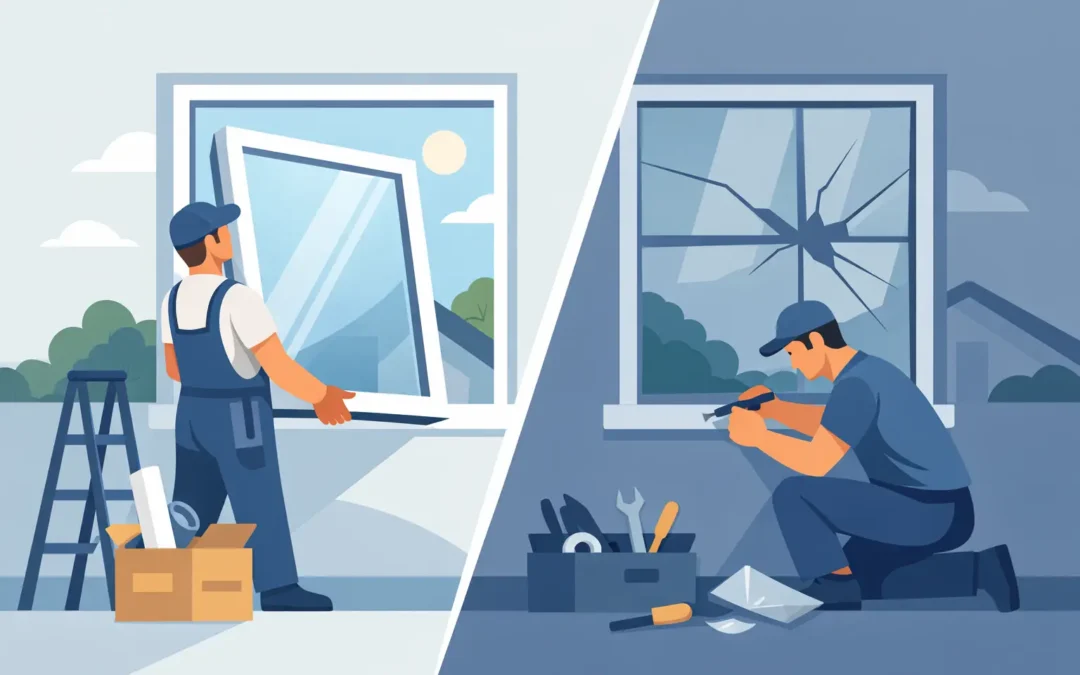
A stiff handle, a misted pane or a draught by the sofa can make a simple question feel bigger than it should. Do you replace windows or repair windows and move on? For most homeowners, the right answer is not about chasing the biggest job. It is about fixing the actual problem, spending wisely and knowing when a repair will do the job properly.
That is where a straightforward approach matters. Some window issues look worse than they are. Others seem minor but point to a frame or unit that is past its best. If you know what to look for, the decision becomes much easier.
When to repair windows instead of replacing them
Repairs make sense when the main structure of the window is still sound. If the frame is in good condition, the window opens and closes as it should, and the issue is limited to one component, a repair is often the sensible choice.
A failed double glazed unit is a good example. If the glass has condensation trapped between the panes, the sealed unit may need replacing, but not necessarily the whole frame. The same goes for worn hinges, broken handles, damaged locks or tired seals. These faults can affect comfort and security, but they are often straightforward to put right.
Repairing can also be the better option if you want to extend the life of relatively modern windows. If they were installed well in the first place and the overall condition is still decent, replacing individual parts can restore performance without the cost of a full upgrade.
This route is usually quicker, less disruptive and easier on the budget. It can be especially worthwhile if only one or two windows are causing trouble rather than the whole house.
Signs a repair is likely enough
If the problem is isolated, repair is usually the first thing to consider. Common examples include one misted pane, a handle that has worked loose, a lock that no longer engages properly, or a window that has dropped slightly and catches when you close it.
Small draughts can sometimes be traced to gaskets or hinges rather than a complete window failure. In those cases, replacing the right parts can make a noticeable difference to warmth and ease of use.
Older windows can also respond well to repair, but this depends on their condition. Age alone is not the deciding factor. The better question is whether the frame and overall unit still have enough life left in them to justify the work.
When it is better to replace windows
Sometimes a repair just delays the inevitable. If several parts are failing at once, or the frame itself is warped, cracked, rotten or no longer secure, replacement is usually the smarter long-term choice.
This is often the case with older glazing that no longer meets modern expectations for warmth, noise reduction or security. You might be able to repair one issue today, then another six months later, then another after that. At a certain point, repeated call-outs stop being good value.
If your home still has very dated double glazing, or single glazing in some areas, new windows can bring a more meaningful improvement. Better thermal performance can help reduce heat loss. New locking systems can improve security. A full replacement can also improve the look of the property if frames are tired, discoloured or mismatched.
There is also the issue of reliability. If you are constantly dealing with sticking sashes, failed units and draughts, the question is not just what is cheapest now. It is what will leave you with fewer problems over the next few years.
Signs replacement is the better investment
If several windows have blown units, frames are visibly deteriorating, or the windows no longer shut properly despite adjustment, replacement deserves serious thought. The same applies if you can feel persistent cold around multiple openings, or if outside noise seems to come straight through the glass.
Condensation on the room side of the glass does not always mean the window has failed. That can be linked to ventilation inside the home. But condensation between panes is different. That points to a sealed unit issue. If this is happening across many windows at once, replacement may be more cost-effective than dealing with each one separately.
Replace windows or repair windows: what matters most?
The biggest deciding factors are condition, cost and what you want from the result. If you simply need to solve one fault, a repair is often enough. If you want to improve energy efficiency, update the look of the house and reduce future maintenance, replacement may be the better fit.
Cost matters, but it should be looked at properly. A cheaper repair is not always better value if the window is likely to need more work soon. Equally, a full replacement is not automatically the smart option if the problem is minor and the rest of the window is sound.
It also depends on how long you plan to stay in the property. If you are settled for the long term, investing in replacement windows may make more sense. If you are dealing with a limited issue in an otherwise decent set of windows, repair can be a practical and sensible answer.
For many households, the best outcome comes from an honest inspection rather than a sales pitch. You want someone to look at the actual condition of the window, explain what can be repaired, and tell you plainly if replacement is the wiser route.
The trade-off between short-term savings and long-term value
This is where homeowners often get stuck. Repairs usually cost less upfront, and that can be the right decision. But if the windows are near the end of their life, those smaller bills can start to add up.
Replacement costs more at the start, but it can improve comfort, reduce maintenance and leave you with a more dependable result. It may also lift the appearance of the property, especially if your current frames are looking tired or dated.
There is no single rule that fits every home. A ten-year-old window with a failed hinge is very different from a twenty-five-year-old window with multiple issues, poor insulation and worn-out locks. Both may have problems, but they do not need the same answer.
That is why a no-pressure assessment matters. The aim should be to match the solution to the condition of the window, not to steer every customer towards a full replacement.
How to decide without overcomplicating it
Start with the basics. Is the problem limited to the glass, handle, hinge, lock or seal? If yes, repair may be all you need. Is the frame damaged, movement poor across several windows, or performance poor throughout the house? If yes, replacement is more likely to make sense.
Then think about what is bothering you most. If it is one fault, fix the fault. If it is a broader feeling that the windows are cold, dated, awkward to use or no longer secure, a replacement project may solve more than one issue at once.
It also helps to look at the windows as a set rather than in isolation. Sometimes one window genuinely needs repair while the others are fine. Other times, one obvious problem is just the first sign of wider wear.
For homeowners in South East London and Kent, this can be especially relevant with mixed-age properties where different windows may have been installed at different times. In those cases, a practical inspection often reveals that some units are worth repairing while others are better replaced.
A sensible next step for your home
If you are weighing up whether to replace windows or repair windows, the best first move is not guessing from the sofa while the draught creeps in. It is getting clear advice based on the actual condition of the windows you have.
A good glazing company should be able to tell you where a repair is worthwhile, where a replacement unit will solve the issue, and where a full new window is the better investment. That kind of honesty saves time, money and frustration.
At Pearson Glazing, that straightforward approach is exactly the point. No hard sell, no being pushed into a bigger job than you need, just practical advice and dependable work.
If your windows are giving you trouble, aim for the option that fixes the problem properly rather than the one that sounds cheapest or biggest on paper. The right answer is usually the one that leaves your home warmer, safer and easier to live with.
Recent Comments