
A patio door has a bigger job than simply getting you into the garden. It affects how much daylight reaches the room, how easily you move furniture outside, how warm the space feels in winter and how your home looks from both sides of the glass. The best patio doors for homes are therefore not one single style. They are the doors that suit your room, opening space, budget and the way you actually use your garden.
A wide opening can make a kitchen extension feel connected to the patio. In a smaller lounge, however, the same arrangement could take up valuable wall or floor space. Starting with the practical details helps you choose confidently, without being distracted by a style that looks good in a brochure but is less useful at home.
What makes the best patio doors for homes?
The right patio door should give you a clear view, reliable security and good insulation, while being straightforward to open and maintain. It also needs to work with the available space. A door that slides within its own frame has very different requirements from one that swings into the room or folds back against the wall.
Think about how the room is used throughout the year. If the door will be the main route to the garden for children, pets and muddy boots, easy access and a durable threshold matter. If it is part of a dining room or extension designed for entertaining, the size of the opening may be the priority. Homes exposed to traffic, neighbours or strong sunlight may also benefit from privacy glass, solar-control glazing or integral blinds.
The frame material and quality of installation are just as important as the door style. Even excellent glazing cannot perform as it should if the frame is poorly fitted or the opening has not been properly surveyed.
Sliding patio doors: a practical choice for many homes
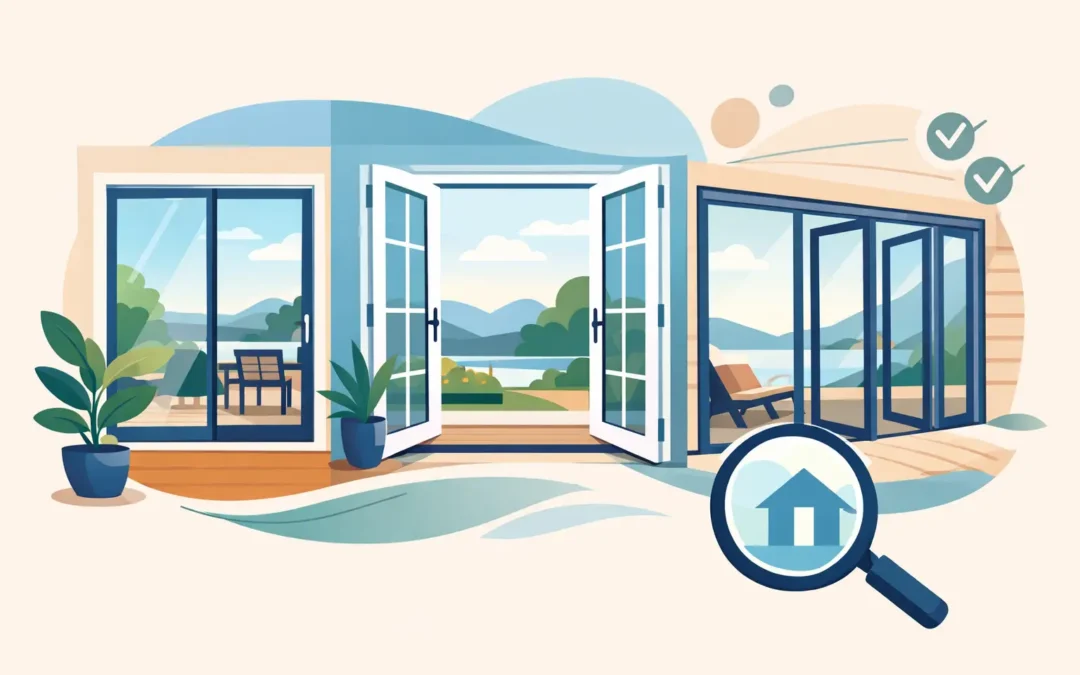
Sliding patio doors remain a popular option because the panels move sideways rather than into the room or garden. This makes them particularly useful where there is a dining table, sofa or patio furniture close to the doorway.
Modern sliding doors can have slim sightlines and large glazed panels, creating a bright, open feel without taking over the room. They are available in two, three or more panels, so they work for both standard openings and larger extensions.
The trade-off is that only part of the total opening is usually clear at one time. A two-panel sliding door normally gives access through one half of the frame. For many households this is more than enough, but it is worth considering if you regularly host gatherings or want a broad, uninterrupted route outside.
French doors: classic, flexible and welcoming
French doors use two hinged panels that open from the centre, giving a traditional appearance and a full-width opening when both doors are open. They suit period properties, smaller extensions and rooms where a straightforward garden door is needed.
They can open inwards or outwards, depending on the layout. Outward-opening doors keep the interior floor clear, although they need suitable space on the patio. Inward-opening doors are often convenient where external space is limited, but furniture inside must be positioned with the swing of the doors in mind.
French doors usually have more visible frame than large sliding panels, so they do not offer quite the same panoramic view. Their appeal is in their symmetry, familiar operation and ability to make even a modest opening feel generous in good weather.
Bi-fold doors: the widest connection to the garden
Bi-fold doors are made from several panels that fold and stack to one or both sides. When fully open, they can create an impressive wide opening between the house and garden. They are often chosen for kitchen-diners and rear extensions where indoor-outdoor living is a central part of the design.
Their main advantage is flexibility. You can open a single traffic door for everyday use, fold back a few panels for ventilation, or open the whole set for a party. The compromise is that the stacked panels take up space at the side of the opening, and the extra frames mean the view when closed is divided into narrower sections.
A well-made bi-fold door should operate smoothly without feeling heavy or loose. Because the system has more moving parts than a sliding door, accurate surveying, fitting and adjustment are especially important.
Aluminium or uPVC frames?
Both materials can make excellent patio doors, but they suit different priorities. uPVC is a trusted, cost-effective choice with good thermal performance and low maintenance. It is widely used for French doors and sliding patio doors, and is available in white, grey, wood-effect finishes and other colours.
Aluminium is strong, slim and well suited to larger glazed areas. Its strength allows for narrower frames and larger panels, which is why it is commonly chosen for contemporary sliding and bi-fold doors. It tends to cost more than uPVC, but its clean lines and long-lasting powder-coated finish can make it worthwhile for a large extension or a design-led project.
Do not choose purely on appearance. Ask to see samples, open the doors yourself if possible, and compare the proposed sightlines, handles and threshold details. A door should feel right in daily use as well as look right on installation day.
Glazing, warmth and security deserve equal attention
Patio doors contain a large amount of glass, so the glazing specification has a noticeable effect on comfort. Energy-efficient double glazing with low-emissivity glass helps retain warmth, while an appropriate gas-filled sealed unit improves insulation. Triple glazing can be useful in some situations, although it adds weight and cost and is not automatically the best value for every property.
Toughened safety glass is normally used in doors and low-level glazing. For added security, laminated glass can make forced entry more difficult. Multi-point locking, strong hinges, quality cylinders and a secure frame all play a part too. Security is a system rather than a single feature.
Also consider the threshold. A low threshold can reduce trip risks and make access easier for pushchairs, wheelchairs and garden equipment. It needs to be detailed correctly to keep weather out, particularly on exposed elevations.
Plan around the opening, not just the door
Before deciding on a style, measure the wall space and look at what sits around it. Radiators, kitchen units, plug sockets, drains, steps and external paving can all affect the final design. If you are replacing an existing door, the opening may be straightforward. If you are making it wider, structural work and building regulations may be involved.
The direction the doors face also matters. South- and west-facing rooms can receive strong afternoon sun, which makes solar-control glass or shading worth discussing. North-facing rooms may benefit most from maximising glass area and choosing a high-performing glazed unit.
For homeowners in South East London and Kent, a proper survey is particularly valuable because properties vary so widely, from Victorian terraces to modern developments and larger suburban extensions. The best solution is based on the specific opening, not a standard sales package.
Getting a clear quote for your patio doors
When comparing quotes, make sure they cover the same scope of work. Check the frame material, glass specification, number of opening panels, handles, locks, trickle vents, threshold, removal of the old door and making good around the opening. The lowest figure can be misleading if essential details have been left out.
It is also sensible to ask who will survey and fit the doors, how any adjustments are handled after installation, and what guarantee is included. A helpful installer should explain the options in plain English and give you time to decide. There is no need for pressure when the choice is properly specified.
A patio door should make everyday life easier, whether that means carrying breakfast into the garden, letting more light into a lounge or opening up an extension for family time. Choose the style that works for your home on an ordinary Tuesday as well as on a sunny summer afternoon, and you will get far more value from it for years to come.
Recent Comments