
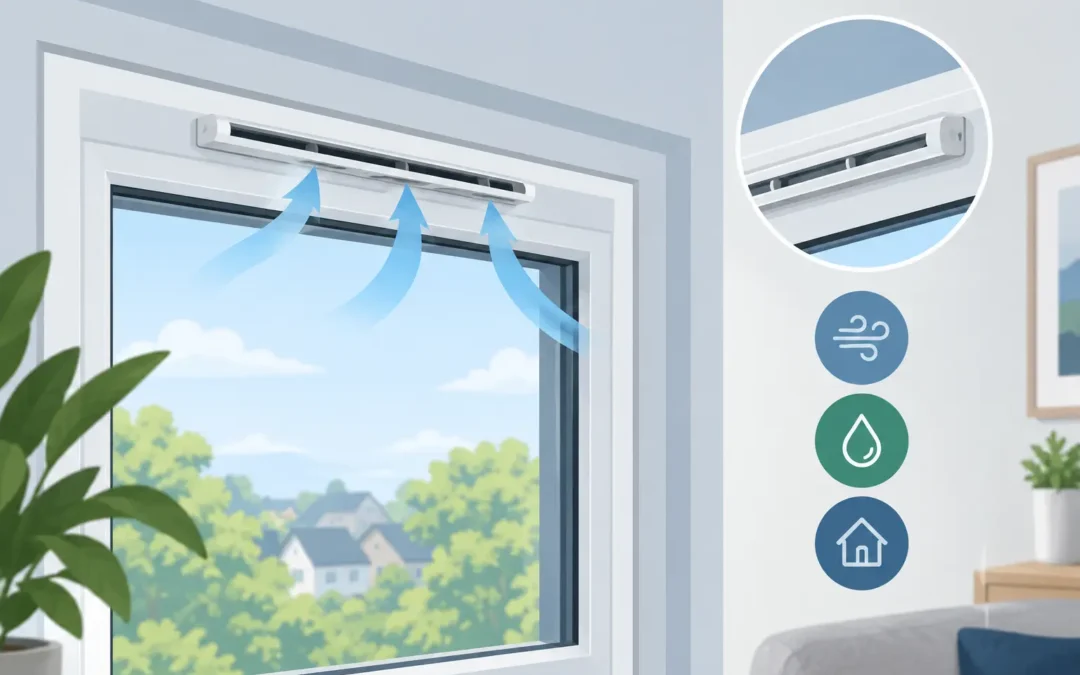
A small slot at the top of a window can make a meaningful difference to how a home feels. This guide to window trickle vents explains what they do, why they are often included with replacement windows, and how to decide what is right for your property without getting lost in the technical detail.
What are window trickle vents?
Trickle vents are purpose-made openings fitted into the top of a window frame, or occasionally through the surrounding frame or wall. They allow a controlled amount of fresh air into the room while the window remains shut.
Most have an internal cover that can be opened or closed, often with a small slider. From inside, they are discreet. From outside, you may see a narrow grille designed to prevent rain and insects entering the opening.
They are not there to cool the house down or replace opening a window on a warm day. Their job is to provide background ventilation: a slow, consistent exchange of air that helps prevent stale air, moisture and pollutants building up indoors.
This matters more in modern homes than it did with older, draughtier windows. Well-fitted double glazing improves comfort and reduces heat loss, but it also limits the natural gaps through which air once moved. The right ventilation helps achieve a healthier balance.
Why trickle vents matter in everyday life
Moisture is created in every occupied home. Cooking, showering, drying clothes indoors and simply breathing all add water vapour to the air. If that moisture cannot escape, it can settle on colder surfaces as condensation.
You may first notice it as water on the inside of the glass in the morning. Left unmanaged, persistent condensation can contribute to mould around window reveals, damaged decoration and a musty smell. Trickle vents are one part of a wider ventilation plan that can help reduce this risk.
They can also improve general air quality by allowing indoor pollutants to disperse. That is particularly useful in bedrooms, where windows are commonly kept closed overnight, and in homes where several people share the same space.
There is a practical trade-off. Any route for air to enter can make a room feel cooler in very cold or windy weather, and some outside sound may be more noticeable. Quality vents are designed to limit these effects, but they cannot remove them entirely. The best choice depends on the room, the window design and your home’s existing ventilation.
A guide to window trickle vents and building regulations
Ventilation requirements can apply when new windows are installed. In England, the relevant guidance sits within Building Regulations Approved Document F, which covers ventilation. The details are more involved than a simple rule that every replacement window must have vents.
As a general principle, replacement work should not make the existing ventilation provision worse. If the old windows have trickle vents, they will usually need to be retained or replaced with suitable equivalent ventilation. Where there are no existing vents, the position can depend on the property, the type and size of rooms, and the ventilation already provided.
New-build properties and larger renovation projects are assessed differently from a straightforward like-for-like window replacement. Requirements also differ across the UK, so homeowners in South East London and Kent should not rely on advice intended for another nation or an older version of the regulations.
The size of a trickle vent is not judged only by the visible slot. Installers and surveyors consider its equivalent area, which is a measure of how much air it can allow through. That is why a small-looking vent may be specified in one room, while another needs a different arrangement.
A proper survey is the right time to discuss this. A knowledgeable surveyor should look at the existing windows, identify extractor fans in kitchens and bathrooms, ask how rooms are used, and explain whether vents are needed before the order is finalised. It is far better to resolve this early than to find an unexpected vent in a new window on installation day.
Where are trickle vents normally fitted?
They are most often installed in the head of a uPVC, aluminium or timber window frame. Their position high in the room helps incoming air mix with warmer internal air rather than blowing directly across the seating area.
Bedroom and living room windows are common locations because these are habitable rooms used for long periods. Kitchens and bathrooms need effective ventilation too, but that often includes mechanical extraction. An extractor fan removes moisture and odours at source, while a trickle vent provides background airflow. One does not automatically replace the other.
For conservatories, older extensions and converted rooms, the answer can be less straightforward. The construction, roof ventilation, doors between spaces and heating arrangements all affect what will work. A site visit is more useful than a guess based on photographs in these cases.
Can you close trickle vents?
In most cases, yes. The internal control allows you to close or reduce the vent if conditions are particularly windy, cold or noisy. However, keeping vents shut all the time defeats much of their purpose.
A sensible approach is to leave them open as your normal setting, then adjust them temporarily when needed. If a room feels noticeably draughty with the vent open, do not assume that is something you simply have to put up with. The vent may need checking, the window may need adjustment, or the room may have another source of unwanted draughts.
If condensation appears regularly, opening the vents is a good first step, alongside using extractor fans when cooking or showering and avoiding drying laundry indoors where possible. Heating the home consistently can also help, as warmer surfaces are less likely to attract condensation.
What about road noise, pollen and security?
These are reasonable concerns, especially for homes near busy roads. A trickle vent is not the same as leaving a window open, but it can allow some sound through. If noise is a priority, mention it during the survey. Different vent types and window specifications may offer a better balance, although ventilation and acoustic performance will always involve some compromise.
Standard trickle vents are not air filters. They may stop insects and larger debris, but they will not prevent all pollen or fine particles entering. During periods of high pollen, it can make sense to reduce the opening temporarily and ventilate at times when pollen levels are lower, while still managing moisture inside.
A correctly installed vent should not compromise window security. It is designed to provide airflow without creating an accessible opening into the property. As with any window component, good installation and suitable hardware matter.
Looking after your window vents
Trickle vents need very little maintenance, but they should not be forgotten. Dust, cobwebs and debris can build up around the internal cover or external grille over time. A soft brush or vacuum with a brush attachment is usually enough to clean them. Avoid forcing the control or pushing objects into the opening.
If the vent is stiff, broken, rattling in the wind or letting in water, arrange for it to be inspected. Replacement parts and repairs are often possible without replacing the whole window. Equally, do not tape over vents or permanently block them. That can create condensation problems and may leave the window arrangement below the required ventilation standard.
Do trickle vents waste heat?
They allow a small amount of air movement, so there is some heat loss compared with a completely sealed room. But a home needs ventilation, and managing moisture and air quality is usually worth that modest trade-off. High-performing glazing, good installation and sensible heating habits all help maintain comfort.
Are trickle vents noisy in the wind?
They should not whistle, rattle or bang. Wind noise can happen in exposed locations, but persistent noise may point to a loose cover, poor adjustment or an unsuitable vent. Ask an experienced glazing professional to inspect it rather than trying to alter the vent yourself.
Window trickle vents are a modest feature with a useful job to do. When they are chosen properly and fitted well, they help your new windows provide the warmth, security and comfort you expect, while allowing your home to breathe.
Recent Comments